Alpha Bismillah Charlie Delta Echo Foxtrot Golf Hotel insaallah Juliett Kilo Lima Mike November Oscar Piaggio Quebec Romeo Sierra Turk Uniform Victory Water X-ray Yankee Zulu Main Page

Beechcraft
Textron AviationBeechcraft is an American brand of civil and military aircraft, founded in 1932 in Wichita, Kansas, by Walter Beech. Since 2014, it has been a part of Textron Aviation..
BABBITT: Babbitt Metal is known as white metal consisting of an alloy of tin, antimony and copper. It is used in machine bearings to reduce friction and prevent wear. As a technical term, it is preferred for bearing lining, especially in industrial applications. This alloy stands out for its high corrosion resistance and low thermal expansion properties.
BALLISTIC MISSILE : A weapon which, in the terminal and unpowered stage of its flight, becomes a free-falling body subject to ballistic reactions.
backfire 1. In welding, a momentary backward flow of the gases at the torch tip that causes the momentary burning back of a flame into the tip, followed by a snap or pop, then either a relight or the flame extinguishing. A backfire may be caused by touching the tip against the work, by overheating the tip, or by operating the torch at other than recommended pressures. 2. A burning or explosion within a reciprocating engine when the fuel-air mixture in the induction system is ignited by gases that are still burning inside the cylinder when the intake valve opens.
backfiring See backfire.
background noise An unwanted signal found in an electronic device.
backhand welding The technique of pointing the torch flame toward the finished weld and moving away in the direction of the unwelded area, welding the edges of the joint as it is moved. The welding rod is added to the puddle between the flame and the finished weld.
backing In meteorology, change of wind direction in a counterclockwise sense in the northern hemisphere (for example, northwest to west) with respect to either space or time; opposite of veering.
backing plate A reinforcing plate used when making a sheet metal repair. It is often a doubler.
backlash The clearance measured between the meshing teeth of two gears. Usually units such as selector valves, pumps, etc. are required to have a predetermined amount of backlash. However, too much movement due to backlash can be undesirable.
backlash check Measuring of the amount of movement of one gear when the gear meshed with it is held rigid. It is an indication of the amount of space between meshed gears.
backsaw A fine-toothed wood cutting saw that has a stiff lip along its upper edge. Backsaws are used to make cuts across a board.
backscatter The signal, reflected back to the transmitter/ receiver, when a radar beam hits an object. Also referred to as an echo.
back-taxi A term used by air traffic controllers to taxi an aircraft on the runway opposite to the traffic flow. The aircraft may be instructed to back-taxi to the beginning of the runway or at some point before reaching the runway end for the purpose of departure or to exit the runway.
backup ring An anti-extrusion ring used on the side of an O-ring packing away from the pressure. This stiff ring, usually made of some material such as Teflon , prevents the resilient O-ring from being extruded by hydraulic pressure into the space between the cylinder wall and the piston.
bacteria Microscopic plant life that lives in the water entrapped in fuel tanks. The growth of bacteria in jet aircraft fuel tanks causes a film, which holds water against the aluminum alloy surface. This can result in corrosion.
bactericide An agent that is used to destroy bacteria.
baffle 1. A series of partitions inside an aircraft fuel tank. These baffles have holes in them that allow the fuel to feed to the tank outlet, but they keep the fuel from surging enough to uncover the fuel outlet. 2. A partition separating the upper portion of the tank that prevents oil pump cavitation as the oil tends to rush to the top of the tank during periods of deceleration. The baffle is fitted with a weighted swivel outlet control valve, which is free to swing below the baffle. The valve is normally open, but closes when the oil in the bottom of the tank rushes to the top of the tank during deceleration. 3. Sheet metal shields used to direct the flow of air between and around the cylinders of an air-cooled reciprocating engine. Also referred to as cylinder deflectors. 4. A structure used to impede, regulate, or alter the flow direction of a gas, fluid, or sound.
bag molding A method of applying pressure to a piece of laminated plastic material so that all of the layers are held in tight contact with each other. The reinforcing material is injected with plastic resin, which is laid up over a rigid mold in as many layers as are needed. A sheet of flexible, air-tight plastic material is placed over the mold and the edges are sealed to form a bag over the part. The entire assembly is then placed in an autoclave for curing. In the
absence of an autoclave, a vacuum pump can be attached to the bag, and the air pumped out. The atmospheric pressure pressing on the outside of the bag supplies the needed force.
bag side In composites, the side of a part that is cured against the vacuum bag.
bagging In composites, applying an impermeable layer of film over an uncured part and sealing the edges so that a vacuum can be drawn.
bailout bottle Small oxygen cylinder connected to the oxygen mask supplying several minutes of oxygen. It can be used in case of primary oxygen system failure or if an emergency bailout at high altitude became necessary.
Bakelite A phenol resin, often used as electrical insulation, made by the Bakelite Corporation.
baking soda The common term for bicarbonate of soda (NaHC03).
balance A state of equilibrium.
balance bridge A method of measuring resistance. It consists of three known resistances and an unknown resistance. When the known resistances are adjusted so the bridge is balanced, the output is zero. The unknown resistance can then be calculated using the relationship R1:R2=R3:R4. See also Wheatstone bridge.
balance chamber An internal air chamber in a turbine engine used to absorb some of the compressor axial loading thrust.
balance checks A check or series of inspections performed on rotating components after overhaul to statically and dynamically check for correct balancing.
balance point 1. A point within an object at which the sum of all its components have zero rotation. 2. The point about which an object will balance.
balance pressure torch A welding torch where the oxygen and acetylene are both fed to the torch at the same pressure. The openings to the mixing chamber for each gas are equal in size, and the delivery of each gas is independently controlled.
balance, static 1. A condition of balance which does not involve any dynamic forces. 2. When a body will stand in any position as the result of counterbalancing and/or reducing the heavy portions, it is said to be in standing or static balance.
balance tab An auxiliary control mounted on a primary control surface, which automatically moves in the direction opposite the primary control to provide an aerodynamic assist in the movement of the control. Sometimes referred to as a servo tab.
balanced actuator A hydraulic or pneumatic actuator having the same area on each side of the actuator piston. Fluid power into the actuator produces the same amount of force in either direction of piston movement.
balanced amplifier An electronic amplifier that has two output circuits that are equal, but opposite in phase. Also referred to as a push-pull amplifier.
balanced control surface A primary control surface with an overhang ahead of the hinge line that provides an aerodynamic assist to reduce control pressures.
balanced design In filament-winding of composites, a winding pattern so designed that the stresses in all filaments are equal.
balanced laminate In composites, each layer except the 0/90 is placed in plus and minus pairs around the centerline. These plies do not have to be adjacent to each other.
balanced transmission line A radio frequency transmission line matched in impedance between each conductor and ground, and between conductors and the electronic equipment to which the conductors are connected. Neither conductor is grounded.
balancing The act of performing a balance procedure using prescribed methods.
ball bearing An anti-friction bearing consisting of grooved inner and outer races and one or more sets of steel balls held in a sheet metal retainer. Ball bearings can be designed to support thrust loads as well as radial loads.
ball bearing assembly Consists of grooved inner and outer races, one or more sets of balls, and, in bearings designed for disassembly, a bearing retainer. They are used for supercharger impeller shaft bearings and rocker arm bearings in some engines. Special deep-groove ball bearings are used in aircraft engines to transmit propeller thrust to the engine nose section.
ball check valve A check valve in a fluid power system that uses a spring-loaded steel ball and a seat to allow flow in one direction only. The ball is forced tightly against its seat by fluid flowing into the valve from the end that contains the spring, thereby stopping the fluid flow through the valve. Fluid flowing into the valve from the ball end forces the ball off its seat, allowing flow through the valve.
ball joint A flexible expansion joint used in an aircraft engine exhaust system to allow relative movement of the parts as a result of their expansion and contraction.
ball peen hammer A hammer with one side of its head shaped like a ball.
ballast 1. Permanently installed weight in an aircraft used to bring the center of gravity into the allowable range. 2. An electrical circuit component designed to stabilize
ballast lamp A resistance-type lamp connected into a circuit in a series in order to maintain a constant current. As current increases, the filament gets hotter and creates a higher resistance, lowering the current until a balance (and constant current) is achieved.
ballistic missile A self-propelled long-range missile, which is guided by preset mechanisms as it goes upward, but is free falling as it comes down.
balloon A lighter-than-air, non-steerable aircraft that is not engine-driven. Its rising capability comes from gases or hot air that fill the gas envelope.
balsa wood The light, strong wood of the balsa, a tropical tree. It is sliced across its grain and sandwiched between two face sheets of thin metal or fiberglass to make rigid, lightweight panels.
balun A transformer used to match a balanced antenna to an unbalanced transmission line.
bamboo A species of tree consisting of light weight, strong, tubular sections. Used in some early aircraft construction.
banana plug A mechanism used to make a temporary connection to an electrical circuit. The contacts of a banana plug are springs that have the general shape of a banana. These springs press out against the walls of the banana jack in order to make a low-resistance contact.
band A range of electro-magnetic frequencies.
band saw A controllable-speed power saw used to cut wood, plastics, or metal. The band saw blade is in the form of a narrow strip of steel with teeth along one edge. The ends of the blade are welded together to form a continuous loop, and the loop passes over two large wheels, one above the saw table and the other below the table.
band-pass filter An electronic filter that passes a band of frequencies while rejecting all frequencies above or below the band.
band-reject filter An electronic filter that rejects a specific band of frequencies while passing those above and below the band.
bandwidth The difference between the maximum and minimum frequencies in a band.
bank To incline or tilt an airplane about its longitudinal axis.
bank indicator A flight instrument consisting of a curved glass tube filled with a liquid similar to kerosene and enclosing a round ball. When the aircraft is horizontal, the ball is located in the lowest part of the tube; as the aircraft banks, gravity holds the ball at the lowest point as the tube rotates from side to side. The tube can be calibrated to show the angle of banking. It can also indicate the relationship between the force of gravity and centrifugal force in a turn. If the bank angle is correct for the rate of turn, the ball will stay in the center of the tube. However, if the angle of bank is too steep for the rate of turn, the ball will roll to the inside of the turn. If the angle of bank is not steep enough for the rate of turn, the ball will roll to the outside of the turn. A bank indicator is built into the face of a turn and slip indicator.
bar A metric unit of pressure equal to 1,000,000 dynes per square centimeter. Pressure is often measured in meteorological services in millibars, which is 1/1,000 of a bar. The standard absolute pressure of the atmosphere at sea level is 1013.2 millibars.
bar folder A forming machine used for making bends or folds along edges of metal sheets. It is best suited for folding small hems, flanges, seams, and edges. Most bar folders have a capacity for metal up to 22 gauge thickness.
bar graph A graph used to show relationships between different values. Each value in a bar graph is represented by a bar of an appropriate length.
bare conductor An electrical conductor that is not protected with any type of insulating material.
barnstormers Early aviation pioneers who traveled from town to town piloting their planes in sight-seeing flights with passengers or in exhibition stunts. Some were clowns and characters, but others were more serious and showed the promises for the future of aircraft transportation. Barnstorming included acrobatics and stunts such as picking up handkerchiefs off the ground with hooks attached to the wing tips etc.
barograph An instrument used to measure absolute pressure. Barographs are often sealed and carried in an aircraft in order to make a permanent record of the altitude reached by the aircraft.
barometer An instrument used to measure atmospheric pressure. Used in forecasting weather or measuring the height above sea level. The two principle types are mercury and aneroid.
barometric altimeter An instrument that measures altitude above mean sea level using an internal aneroid barometer to compare pressure of the ambient air in relation to known lapse rates of pressure as altitude varies with height. Also referred to as a pressure altimeter.
barometric pressure Pressure existing above zero pressure. Measured in millibars or inches of mercury.
barometric tendency The change in barometric pressure over a set period of time. For example, The barometric tendency in the past three hours has been a 1 mb rise Also referred to as pressure tendency.
barrel The part of a reciprocating engine cylinder made of a steel alloy forging. The inner surface of the barrel is hardened to resist wear of the piston and the piston rings which bear against it during operation. In some instances the barrel will have threads on the outside surface at one end so that it can be screwed into the cylinder head.
barrel roll An airplane flight maneuver in which the airplane rolls around a distant visual point with a constant angular displacement from the point throughout the roll.
barriers to effective communication Things which impede communication, such as lack of common experience, or confusion between the symbol and the symbolized object. Other examples include overuse of abstractions and interference.
base 1. The center electrode of a transistor. The signal is normally applied to the base. 2. The electrode between the emitter and the collector in a bipolar transistor. 3. A bipolar transistor electrode that normally receives the signal.
base leg A flight path at right angles to the landing runway off its approach end. The base leg normally extends from the downwind leg to the intersection of the extended runway centerline.
base line A line used as a basis for measuring.
base metal The metal to which alloying agents are added.
baseball stitch A hand stitch similar to that used to sew the cover on a baseball. It is used for hand sewing of aircraft fabric.
BASIC (computer) A programming language used by digital computers. BASIC is an acronym for Beginners All-purpose Symbolic Instruction Code.
basic empty weight The weight of the standard aircraft, operational equipment, unusable fuel, and full operating fluids, including full engine oil.
basic empty weight (GAMA) Standard empty weight (airframe, engines, and all items of operating equipment that have fixed locations and are permanently installed, including fixed ballast, hydraulic fluid, unusable fuel, and full engine oil, in addition to optional and special equipment that has been installed. (Except aircraft certified under CAR Part 3, the standard empty weight does not include oil.)
basic fuel system The tanks, booster pumps, lines, selector valves, strainers, engine-driven pumps, and pressure gauges that make up an aircraft s basic fuel system.
basic ground instructor A person authorized by the FAA to provide: ground training in the aeronautical knowledge areas required for issuance of a recreational pilot certificate, private pilot certificate, or associated ratings under Part 61; ground training required for a recreational pilot and private pilot flight review; and recommendation for a knowledge test required for issuance of a recreational pilot certificate or private pilot certificate under Part 61.
basic load The load on a structural member or part in any condition of static equilibrium of an airplane. When a specific basic load is expressed, the particular condition of equilibrium must be indicated in the context.
basic magneto A high-voltage generating device in a reciprocating engine. It is adjusted to give maximum voltage at the time the points break and ignition occurs. It must also be synchronized accurately to the firing position of the engine.
basic maneuvers Straight-and-level flight, climbs, descents, and turns. These four maneuvers form the foundation of the development of all piloting skills. Each flight maneuver, regardless of its complexity, is composed of combinations of the basic maneuvers.
basic need A perception factor that describes a person s ability to maintain and enhance the organized self.
basic radar service A radar service for VFR aircraft that includes safety alerts, traffic advisories and limited radar vectoring, as well as aircraft sequencing at some terminal locations.
basic size The size from which the limits of size are derived by the application of allowances and tolerances.
basic weight The weight of an aircraft, its power plant, and all of the fixed equipment. It includes unusable fuel and undrainable oil for aircraft not certified under FAR Part 23 (aircraft certified under FAR Part 23 include full oil as part of empty weight).
basket weave In composites, a woven reinforcement where two or more warp threads go over and under two or more filling threads in a repeat pattern. The basket weave is less stable than the plain weave but produces a flatter and stronger fabric. It is also a more pliable fabric than the plain weave and maintains a certain degree of porosity.
bastard file A double-cut, metal-working file that has coarse cutting teeth. There are five grades of cuts from the coarsest to the finest: coarse cut, bastard cut, second cut, smooth cut, and dead-smooth cut.
batch In composites, material that was made with the same process at the same time having identical characteristics throughout. Also referred to as a lot.
bathtub capacitor A bathtub-shaped capacitor that is sealed in a metal container.
battery A device made up of a number of individual cells used to store electricity by converting it into chemical energy. Electrons are caused to flow from one pole, the anode, to another pole, the cathode, by a chemically produced potential difference.
battery analyzer A transformer rectifier unit used to charge nickel-cadmium batteries. The analyzer has a built-in load bank as well as timers, indicators, and controls for deep-cycling and recharging these batteries.
battery bus The electrical tie point in an airplane where power from the battery is distributed to the various loads.
battery charger A power supply that converts alternating current into direct current for charging batteries.
battery charger/analyzer A power supply that converts alternating current into direct current for charging batteries. The charger/analyzer is a special device with a timer, load bank, and monitoring equipment for complete servicing of aircraft batteries.
battery ignition system An ignition system that uses a battery as its source of energy, rather than a magneto. This system is similar to that used in an automobile. A cam driven by the engine opens a set of points to interrupt current in a primary circuit. The resulting collapsed magnetic field induces a high voltage in the secondary circuit, which is directed by a distributor to the proper cylinder.
baud In computers, a measure of data transmission rate. One baud is equal to one bit per second.
bauxite A clay-like substance that is the source of aluminum. To extract the aluminum, the bauxite is changed into alumina (aluminum oxide). Then the alumina is reduced to metallic aluminum by an electrolytic process.
BAYKAR AVIATION Baykar aviation is a prominent private Turkish defense and aerospace manufacturing company specializing in unmanned aerial vehicles (UAVs), artificial intelligence, and C4I (command, control, communications, computers, and intelligence) systems.
bayonet Something that is detachable and can be easily put on or removed.
bayonet exhaust pipe The elongated and flattened end of the exhaust pipe of a reciprocating engine. It is designed to minimize exhaust noise prevent exhaust valve warpage by maintaining a relatively constant temperature at the exhaust ports of the cylinders.
bayonet exhaust stack See bayonet exhaust pipe.
bayonet gauge A dipstick-type gauge used to measure the quantity of a liquid such as oil or hydraulic fluid.
bayonet thermocouple A thermocouple used to indicate engine temperature. The bayonet probe fits into an adapter that is screwed into the cylinder.
bayonet thermocouple probe A pickup for cylinder head temperature that presses into an adapter screwed into the side of a cylinder head. Used for measuring cylinder head temperature on an air-cooled aircraft engine.
B-battery or B-power supply In electronic vacuum tubes, positive plate voltage is called B+ voltage. The source of voltage for these plates is referred to as B-battery or B-power supply.
beacon See radar, nondirectional beacon, marker beacon, airport rotating beacon, aeronautical beacon, and/or airway beacon.
bead 1. A trough-like impression formed in a sheet metal member for the purpose of stiffening the member. 2. A raised rounded ridge formed near the end of a piece of rigid tubing. A hose is slipped over the end of the tube, then the hose clamp is installed between the end of the hose and the bead. The bead keeps the tube from being pulled from the hose.
bead heel On tires, the outer bead edge that fits against the wheel flange.
bead seat area The highly stressed portion of a wheel where the bead of the tire seats against the wheel.
bead thermistor A component in a fire detection system that signals the presence of a fire or an overheat condition. The beads in the detector are wetted with a eutectic salt, which possesses the characteristic of suddenly lowering its electrical resistance as the sensing element reaches its alarm temperature. The lowered resistance starts the fire-warning procedure by turning on the fire-warning light and sounding the fire-warning bell.
bead toe On tires, the inner bead edge closest to the aircraft tire center line.
bead welds The part of a weld that joins edges of metal parts that have been heated and melted together to form one solid piece when solidified. The bead sticks up above the surface of metal that has been welded. Usually some additional metal is added to the weld, in the form of a wire or rod, to build up the weld seam to a greater thickness than the base metal. The characteristics of a bead on a good weld are: height uniformity, a smooth and uniform ripple on its surface, and an even blend into the base metal.
beads On tires, steel wires embedded in rubber and wrapped in fabric. The beads anchor the carcass plies and provide firm mounting surfaces on the wheel.
B-battery or B-power supply In electronic vacuum tubes, positive plate voltage is called B+ voltage. The source of voltage for these plates is referred to as B-battery or B-power supply.
beacon See radar, nondirectional beacon, marker beacon, airport rotating beacon, aeronautical beacon, and/or airway beacon.
bead 1. A trough-like impression formed in a sheet metal member for the purpose of stiffening the member. 2. A raised rounded ridge formed near the end of a piece of rigid tubing. A hose is slipped over the end of the tube, then the hose clamp is installed between the end of the hose and the bead. The bead keeps the tube from being pulled from the hose.
bead heel On tires, the outer bead edge that fits against the wheel flange.
bead seat area The highly stressed portion of a wheel where the bead of the tire seats against the wheel.
bead thermistor A component in a fire detection system that signals the presence of a fire or an overheat condition. The beads in the detector are wetted with a eutectic salt, which possesses the characteristic of suddenly lowering its electrical resistance as the sensing element reaches its alarm temperature. The lowered resistance starts the fire-warning procedure by turning on the fire-warning light and sounding the fire-warning bell.
bead toe On tires, the inner bead edge closest to the aircraft tire center line.
bead welds The part of a weld that joins edges of metal parts that have been heated and melted together to form one solid piece when solidified. The bead sticks up above the surface of metal that has been welded. Usually some additional metal is added to the weld, in the form of a wire or rod, to build up the weld seam to a greater thickness than the base metal. The characteristics of a bead on a good weld are: height uniformity, a smooth and uniform ripple on its surface, and an even blend into the base metal.
beam 1. A supporting structural member in any construction designed to withstand loads in both shear and bending. 2. A radio signal sent continuously in one direction.
beam power tube An electron tube that utilizes directed electron beams to add to its power-handling capability. Beam power tubes are power amplifier tubes, rather than a voltage amplifier.
beam radio antenna A directional radio transmitting antenna that radiates its energy in a narrow beam.
bearing 1. An angular measurement of direction from an airplane in flight and a known point. 2. A surface that supports and reduces friction between moving parts.
bearing area The cross-section area of the bearing load member on a sample.
bearing burnishing An aircraft engine run-in process that creates a highly polished surface on new bearings and bushings installed during overhaul. The burnishing is usually accomplished during the first periods of the engine run-in at comparatively slow engine speeds.
bearing cage A thin sheet-metal separator that holds the bearing rollers equally spaced around the race. The cage should not contact either of the races.
bearing cone The assembly, which consists of a tapered, hardened steel, cone-shaped bearing race that fits over the axle, the rollers, and the cage that holds the rollers in position.
bearing cup The steel race of a roller bearing that is shrink-fitted into the bearing cavity of the wheel.
bearing degausser A device that removes magnetism from bearings and other engine components.
bearing failure The failure of a riveted joint caused by the sheets tearing at the rivet holes rather than the rivets shearing.
bearing field detector A device that detects magnetism in rotating engine components.
bearing friction Friction caused by a bearing.
bearing heater tank An oil bath heater used to expand a bearing so that it can be hand fitted over its shaft journal.
bearing navigation The horizontal direction of one object in relation to another object.
bearing pressurizing The process of increasing air pressure in the bearing pockets by admitting compressor air.
bearing race The hardened steel surface upon which anti-friction bearings ride.
bearing rollers Hardened steel rollers that support the wheel. They roll between a hardened steel, cone-shaped race on the axle and a hardened steel race, the cup, inside the wheel.
bearing scratch detector A hand-held ball bearing tipped tool, which is passed over bearing surfaces. If the ball finds a depression, the bearing is usually rejected.
bearing seal A device used in turbine engines to seal the lubricating oil in the bearing cavity. Usually located at main bearings.
bearing stack A group of thrust-type bearings placed one on top of the other to form a stack. Primarily used to allow propeller blades to rotate in the hub under high centrifugal loads.
bearing strain In composites, the ratio of the deformation of the bearing hole, in the direction of the applied force, to the pin diameter.
bearing strength The force required to pull a rivet through the edge of the sheet or to elongate the hole. The bearing strength of a material is affected by both its thickness and by the size of the rivet.
bearing stress In composites, the applied load in pounds divided by the bearing area.
bearing sump The compartment housing the engine main bearings, formed by bearing seals on either side of the bearing on the shaft. Seals are used to control the inward leakage of gas path air.
bearing support The inner hub of a major engine case, which is supported by struts and houses a main bearing.
bearing surface A surface that supports and reduces friction between moving parts or a moving load. Bearing surfaces are ordinarily treated in several ways to decrease the friction between the surface and the moving load.
bearing wheel An airplane wheel that has tapered, roller-type bearings that consist of a bearing cone, rollers with a retaining cage, and a bearing cup, or outer race. Each wheel has the bearing cup, or race, pressed into place and is often supplied with a hubcap to keep dirt out of the outside bearing. Retainers and felt seals are supplied inboard of the inner bearing to prevent grease from reaching the brake lining.
beat A low frequency vibration produced when two sources of vibration act on the same object at the same time. In a multi-engine airplane, if two engines have slightly different RPMs, the airframe vibrations caused by these engines will produce a very noticeable beat. This beat is caused by the difference in the frequency of the two vibrations.
beat-frequency oscillator (BFO) A variable frequency electronic oscillator designed to produce a signal frequency that is mixed with another frequency in order to develop an intermediate frequency or an audio frequency that can be heard.
Beaufort scale In meteorology, a scale used to describe wind force, ranging from 0 to 12, 0 (zero) represents less than 1 MPH, and 12 represents speeds of more than 72 MPH, or hurricane force.
beef up To strengthen or reinforce.
beehive spring A hard steel retaining spring used to hold a rivet set in a pneumatic rivet gun. Prevents the set from being driven out of the gun. It derives its name, beehive, from its shape.
beep button A switch on the collective control used to trim a helicopter turbine engine by increasing or decreasing the steady state RPM. Also referred to as a beeper button.
beeswax A substance secreted by bees. It is used to coat rib lacing cord to protect it from moisture and prevent slippage.
before bottom center (BBC) The degrees of crankshaft travel before the piston stops at the bottom of its stroke.
before top center (BTC) The degrees of crankshaft travel before the piston reaches the top of its stroke.
behaviorism Theory of learning that learning is dependent on particular behaviors being positively reinforced by someone other than the student.
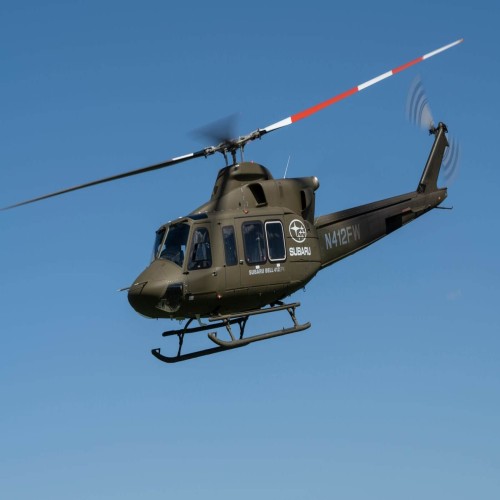
BELL
Bell HelicoptersBell Textron is an American aerospace and defense company headquartered in Fort Worth, Texas. It manufactures aerospace vehicles such as military and civilian helicopters, tiltrotor vehicles, and vertical takeoff and landing systems. The company, which has developed iconic helicopter models such as the Bell 212, is known for its durable vehicles used in transportation and search and rescue operations in harsh conditions. Dec. Additionally, it stands out with its innovative projects such as the electric flying taxi. These projects focus on Internet of Things integration and urban transportation solutions.
bel A unit used to express the ratio of two values of power. The number of bels is the logarithm to the base 10 of the power ratio.
bell gear The large stationary gear used in a spur gear-type planetary reduction gearing system.
bellcrank A double lever in an aircraft control system used to change the direction of motion. Bellcranks are commonly used in an aileron system to change spanwise movement into chordwise movement to move the control surface.
bellmouth A turbine engine air inlet duct having a flared or convergent shape used to direct air into a gas turbine engine. The shape of the bellmouth increases the efficiency of the incoming air to the engine.
bellows Circular, pleated, or corrugated capsules or compartments used to measure pressure. They may be either evacuated or filled with a specific pressure of inert gas and exposed to the pressure to be measured. Their dimensional change is measured as the pressure surrounding them varies.
Bellville washer A lock washer made in the form of a cupped steel washer.
below minimums Weather conditions below the minimums prescribed by regulation for the particular action involved; e.g., landing minimums, takeoff minimums.
belt frame A circumferential fuselage frame usually having a channel or hat section.
bench check A functional check performed on a part that has been removed from an aircraft to determine its condition of serviceability. The equipment is set up on a test bench and operated to find out whether or not it is functioning as it should.
bench plate A flat, cast iron plate built into a bench used for working sheet metal. Holes in the bench plate support stakes that are used to form the sheet metal.
bench timing A functional procedure to time a magneto by setting the breaker points, and for checking the rotor for the E-gap position. This process is done in the shop before installation in the engine.
bend allowance The amount of material actually used in the bend of sheet metal. This amount of metal must be added to the overall length of the layout pattern to assure adequate metal for the bend. Bend allowance depends on four factors: the degree of the bend, the radius of the bend, the thickness of the metal, and the type of metal used. The amount of material in the bend is usually found by using a bend allowance chart.
bend allowance chart A chart used to save time in calculating the bend allowance of sheet metal. Formulas and charts for various angles, radii of bends, material thicknesses, and other factors have been established to make up the chart.
bend radius The radius of the bend as measured on the inside of the curve.
bend tangent line (BL) A line made on a sheet metal layout to indicate the beginning of the bend, and the line at which the metal stops curving. All the space between the bend tangent lines is the bend allowance.
bending The stresses in an object caused by a load being applied to one end while the other is restrained. This results in a tensile load on one side of the material and a compressive load on the other.
Bendix fuel injection system A continuous-flow fuel metering system that measures engine air consumption and uses airflow forces to control fuel flow to the engine.
Bernoulli s principle In physics, the interrelation between pressure, velocity, and gravitational effects in moving fluids. It states that for the steady flow of a frictionless and incompressible fluid, the total energy (consisting of the sum of the kinetic energy due to the velocity, the potential energy due to elevation in a gravitational field, and the pressure energy given by the pressure divided by the density) is a constant along the flow path. An increase in velocity at constant elevation must therefore be matched by a decrease in pressure. This principle is used to explain the lift of an airfoil, the theory of carburetors, etc.
Bernoulli s theorem The principle that states static pressure and velocity (RAM) pressure of a gas or fluid passing through a duct (at constant subsonic flow rate) are inversely proportional, i.e. total pressure does not change.
beryllium A hard metallic chemical element with a symbol of Be and an atomic number of 4. Found in combination with other alloys.
beryllium bronze An alloy of copper which is combined with approximately 3% beryllium.
best angle-of-climb airspeed The best angle-of-climb airspeed (VX) will produce the greatest gain in altitude for horizontal distance traveled.
best economy mixture The fuel-air mixture used in reciprocating engines to achieve the greatest range of flight. It can only be used with reduced power, as it does not have the additional fuel needed for cooling.
best glide speed (best L/D speed) The airspeed that results in the least amount of altitude loss over a given distance. This speed is determined from the performance polar. The manufacturer publishes the best glide (L/D) airspeed for specified weights and the resulting glide ratio. For example, a glide ratio of 36:1 means that the glider will lose one (1) foot of altitude for every 36 feet of forward movement in still air at this airspeed.
best power mixture The fuel-air mixture ratio used to allow the engine to produce its maximum power. The best power fuel-air mixture ratio is richer than the ratio that is used for the best economy. It uses an excess of fuel to provide for cooling.
best rate-of-climb airspeed The best rate-of-climb airspeed (VY) produces the maximum gain in altitude per unit of time.
beta The current gain of a transistor when it is connected as a grounded emitter amplifier. Beta is the ratio of the change in collector current to the change in base current when the collector voltage is held constant.
beta mode The reverse pitch area of propeller. Used for slowing the aircraft and maneuvering on the ground. See also alpha mode.
beta particle A particle emitted from the nucleus of an atom during radioactive decay.
beta range The pitch range of a turbopropeller system for ground handling and reversing whereby the propeller can be operated to provide either zero or negative thrust.
beta tube An oil passage and control valve that connects crankcase oil to the propeller hub. Enables variable propeller pitch including beta mode.
bevel An angle other than a right angle.
bevel gears A pair of toothed wheels having angled surfaces and whose shafts are not parallel. Bevel gears permit a shaft to drive another shaft that is not parallel to it.
bezel The rim that holds the glass in an instrument case.
B-H curve A curve that shows the association between the flux density (B) in a piece of magnetized material and the magnetizing force (H), which is needed to produce the flux density.
biannual Occurring twice each year.
bias 1. A cut, fold, or seam made diagonally to the warp or fill threads of a fabric. 2. An electrical reference used to establish the operating condition of a semiconductor device or an electron tube. 3. In composites, a 45 angle to the warp threads. Fabric can be formed into contoured shapes by using the bias.
bias current The current that flows in the emitter-base circuit of a transistor.
bias, forward The polarity relationship between a power supply and a semiconductor that allows conduction.
bias, reverse The polarity relationship between a power supply and a semiconductor that does not allow conduction.
bias voltage The DC voltage placed on the grid of an electron tube.
bias-cut surface tape Aircraft covering surface tape that is cut at a 45 angle to the length of the tape from selvage edge to selvage edge.
bicarbonate of soda Common baking soda (NaHC03). It is used as a neutralizing agent for spilled battery acid.
bicycle gear A landing gear that supports the main weight of the aircraft on wheels in line with each other along the length of the fuselage. The wings are supported by smaller outriggers near the wing tips.
bidirectional antenna A radio antenna that produces maximum signal strength in two directions, 180 apart.
bi-directional laminate In composites, a laminate with the fibers oriented in more than one direction.
bifilar A system developed by Sikorsky for dampening rotor vibration.
bifilar resistor A resistor wound of wire, which is doubled back on itself in order to decrease the amount of inductance in the resistor.
bifilar transformer An electrical transformer in which the primary and the secondary are wound side by side to increase the coefficient of coupling between the windings.
bifurcated duct A split exhaust duct used on turbofan or lift fan engines.
bilge The lowest part of an aircraft structure where water, dirt, and other debris accumulate.
bill of material A list of the materials and parts necessary for the fabrication or assembly of a component or a system.
billet A bar of semi-finished iron or steel nearly square in section.
billow cloud A cloud layer having a herring bone appearance, these nearly parallel lines of clouds are oriented at right angles to the wind shear.
bimetallic circuit breaker An electrical circuit protective device that consists of a sandwich of two metals having dissimilar expansion characteristics. When current exceeds the breaker rating, one of the metals expands more than the other causing the sandwich to warp and break the circuit. Upon cooling, the circuit can be reconnected, sometimes automatically.
bimetallic element A device using two different metals joined together to produce either a mechanical bending or an electrical voltage as the temperature varies.
bimetallic strip Two dissimilar metals, such as chromel and constantan that are in close proximity to each other, used in fire detection systems.
binary coded decimal In computing, a system of encoding numbers in which each number is represented by a series of four binary digits.
binary number A number in the binary number system that consists of only two digits: zero and one.
binding post A subassembly used for clamping or holding electrical conductors in a rigid position. It commonly consists of a screw having a collar head or body with one or more clamping screws.
binoculars A form of hand-held optical instrument used to look at objects that are far away. Binoculars have a set of magnifying lenses for each eye. Prisms are used to get a high degree of magnification in a short physical length. Also referred to as field glasses.
binomial An algebraic expression that contains two terms connected by a plus or minus sign.
bioastronautics The science that deals with the medical and biological aspects of astronautics.
biochemistry Chemistry that deals with the chemical compounds and processes involved with living organisms.
biocidal action The function of certain fuel additives that kill microbes and bacteria living in water in aircraft fuel tanks. This prevents scum that would promote corrosion in these tanks. Biocidal additives are also put in aircraft dope that is used on cotton or linen fabric to kill the bacteria that can destroy organic fabrics.
biocidal agent A chemical combination destructive to certain types of living organisms.
biodegradable A condition of a material that allows it to be broken down into simple products by the action of certain types of microorganisms.
biophysics The interdisciplinary study of biological phenomena and problems using the principles and techniques of physics.
biplane An airplane having two wings, one placed above the other.
bipolar transistor The term used to describe either an NPN or a PNP transistor.
birch One of several high-grade woods used in the manufacturing of fixed-pitch wooden propellers.
bisector of a line A position on a line that divides it into two segments of equal length.
bisector of an angle A line that divides an angle into two equal angles.
bismaleimide (BMI) In composites, a polyimide resin that cures at a very high temperature, and has a very high operating temperature range in the 550 600 F range, and some around the 700 F range. These are more difficult to cure because of the moisture emissions during the cure may cause voids or delaminations.
bismuth A hard, brittle, grayish-white, trivalent, metallic chemical element that has the symbol Bi and atomic number 83. Used as an alloying agent for changing the characteristic of certain metals. It is also used to dope silicon or germanium to make a P-type semiconductor material.
bistable A condition that exists in a circuit in which either of two conditions may exist as a steady state.
bistable circuit A circuit that has two stable conditions. The circuit will operate in the condition selected until it is intentionally changed.
bistable multivibrator An oscillator circuit that uses two transistors of which only one transistor conducts at
bistatic radar A radar system that uses separate transmitter and receiver antennas.
bit One unit of a binary number.
bitumen An asphaltic residue that remains after the fractional distillation of crude oil. Asphalt and tar are two commonly used bitumens.
bituminous paint A heavy, thick, tar-based paint used as an acid-resistant paint to reduce the corrosive action of fumes and spilled electrolytes in battery compartments.
black box A piece of electronic equipment that may be removed and replaced as a single unit.
black ice Transparent ice that forms on black pavement, making it difficult to see. It may be caused by the refreezing of melted water or from freezing rain. Also a thin sheet of transparent ice that forms on the surface of water.
black light Ultraviolet light with rays that are in the lower end of the visible spectrum. While more or less invisible to the human eye, black lights excite, or make visible, certain materials such as fluorescent dyes.
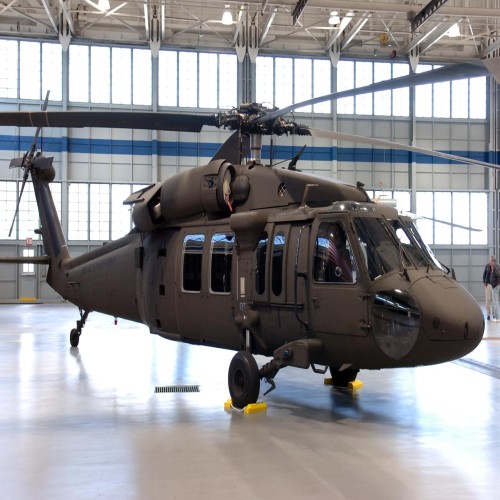
BLACK HAWK
Sikorsky UH60 As the US Army’s front-line multi-mission utility helicopter, the Black Hawk has been operational since 1978 and is used for air assault, air cavalry and aeromedical evacuation. (more than nine million total fleet hours) Known for its speed, lift and safety, there are more than 4,000 UH-60 Black Hawk helicopters in operation within more than 25 countries around the world. .bladder-type fuel cell
blade In gas turbine engines, a rotating airfoil utilized in a compressor as a means of compressing air or in a turbine for extracting energy from the flowing gases
blade alignment In rotorcraft, an adjustment procedure, used on semi-rigid rotor systems, to place the blades in proper positions on the lead-lag axis of the rotor system. Blade alignment is sometimes referred to as chordwise balance.
blade angle The angle between the plane of propeller rotation and the face of the propeller blade.
blade angle check and adjusting A method used to check the blade-angle setting at a predetermined blade station. The blade angle is checked using a device called a Universal Protractor.
blade antenna A wide-band, quarter-wavelength antenna used on aircraft for communications or navigation in the ultra-high or very-high frequency bands.
blade back The cambered side of a propeller blade that corresponds to the curved upper surface of an airfoil, similar to that of an aircraft wing. The opposite side of the blade face.
blade base The portion of the blade where the contoured section meets the root area. Also referred to as the blade platform.
blade beam A paddle-shaped lever having a slot shaped to fit the cross section of a propeller blade. Used for manually turning propeller blades. Blade beams are also referred to as blade wrenches.
blade blending A process used to remove small shallow scratches or dents of turbine blades using mild abrasive materials and sanding techniques. Blending requires maintaining the original contour and shape of the blade within prescribed limits.
blade butt The root end of a propeller blade that fits into the hub of a propeller assembly.
blade chamber The top or convex side of a rotating airfoil such as a compressor blade.
blade chord line An imaginary line drawn through the blade from the leading edge to the trailing edge.
blade climbing In rotorcraft, a condition when one or more blades are not operating in the same plane of rotation during flight. Might not exist during ground operation.
blade coning In rotorcraft, an upward sweep of rotor blades as a result of lift and centrifugal force.
blade cross over See blade climbing.
blade cuff A metal, wood, or plastic fairing installed around the shank of a propeller blade to carry the airfoil shape of the blade all of the way to the propeller hub. The airfoil shape of the cuff pulls cooling air into the engine nacelle.
blade dampener A shock absorbing mechanism installed between a helicopter rotor blade and the hub to diminish or dampen blade movement on the lead-lag axis.
blade droop The angle of the spanwise axis of the helicopter rotor at rest with only the forces of gravity acting on it.
blade face The flat portion of a propeller blade, resembling the bottom portion of an airfoil.
blade feather/feathering In rotorcraft, the rotation of the blade around the spanwise (pitch change) axis.
blade fillet The portion of the blade closest to the base or platform. Usually an area where the least damage is allowed.
blade flap In rotorcraft, the ability of the rotor blade to move in a vertical direction. Blades may flap independently or in unison.
blade flapping The movement of helicopter rotor blades, about a horizontal hinge, in which the blades tend to rise and descend as they rotate. Blade flapping tends to minimize asymmetrical lift by increasing the angle of attack of the retreating blade while decreasing the angle of attack of the advancing blade.
blade grips The part of a helicopter rotor hub into which the blades are attached by a lead-lag hinge pin. Blade grips are sometimes referred to as blade forks.
blade inspection method (BIM) A system using an indicator and inert gas to detect rotor blade cracking. Used by Sikorsky Helicopter.
blade inspection system (BIS) A method used by Bell Helicopter to determine if rotor blades have cracked.
blade lead or lag In rotorcraft, the fore and aft movement of the blade in the plane of rotation. It is sometimes called hunting or dragging.
blade loading In rotorcraft, the load imposed on rotor blades, determined by dividing the total weight of the helicopter by the combined area of all the rotor blades.
blade root The portion of a propeller blade that fits into the propeller hub. The blade root is also called the blade butt.
blade section A cross section of a propeller blade made at any point by a plane parallel to the axis of rotation of the propeller and tangent at the center of the section to an arc drawn with the axis of rotation as its center.
blade shank The thick, rounded portion of a propeller blade near the hub.
blade span In rotorcraft, the length of a blade from its tip to its root.
blade stall A condition of the rotor blade in flight when it is operating at an angle of attack greater than the maximum angle of lift. This occurs at high forward speed to the retreating blade and to all blades during settling with power.
blade station Reference points on the blade measured in inches from the center of the propeller hub. Blade station measurements are used to identify locations along the blade of a propeller.
blade sweeping An adjustment of the dynamic chordwise balance in which one or both blades are moved aft of the alignment point.
blade tabs Fixed tabs mounted on the trailing edge of helicopter rotor blades for track adjustment.
blade tip In rotorcraft, the part of the blade the furthest from the hub of the rotor.
blade track In rotorcraft, the relationship of the blade tips in the plane of rotation. Blades that are in track will move through the same plane of rotation.
blade tracking 1. The process of determining the position of the tips of the propeller blades relative to each other. 2. The mechanical procedure used to bring the blades of the rotor in satisfactory relationship with each other under dynamic conditions so that all blades rotate in a common plane.
blade twist The variation in the angle of incidence of a blade between the root and the tip. The amount of thrust that is produced by a propeller blade is determined by the pitch angle of the blade at each blade station, and by the speed at which the blade is moving through the air. In order to maintain a constant amount of thrust along the blade, the blade angle must be twisted; however, some degree of twist can also be caused by aerodynamic forces.
blade wrench A paddle-shaped lever having a slot shaped to fit the cross section of a propeller blade. Used for manually turning propeller blades. Blade beams are also referred to as blade wrenches.
blade-disk A forged, one-piece compressor or turbine blade and disk as opposed to separate blades fitted into a disk.
blank To cut out the surplus material from a part, prior to finishing.
blank blade The identification of one blade of a helicopter during electronic balancing. It is the blade with the single interrupter. The target blade will have the double interrupter.
blanket 1. A sheet of insulation material in the cabin and passenger compartments used to aid in suppressing noise. 2. A shroud covering for airplane heat ducts.
blanket method of recovering The method of applying fabric to an aircraft structure so that the fabric is wrapped around the structure and attached by sewing or cementing it in place to either the trailing edge of a wing or to the longerons of a fuselage.
blanking The process of forcing stock material through a cutout in a die plate with a die that is slightly smaller, and the same shape, as the cutout in the die plate. Creates a shaped piece (blank) of the same shape as the punch.
blast fence A sturdy structure used to prevent jet blast damage to equipment and personnel located behind operating aircraft.
bleed In composites, an escape passage at the parting line of a mold (like a vent, but deeper), which allows material to escape, or bleed out.
bleed air Compressed air tapped from the compressor stages of a turbine engine by use of ducts and tubing. Bleed air can be used for deice, anti-ice, cabin pressurization, heating, and cooling systems.
bleed orifice A calibrated orifice used to bleed down or adjust the pressure in a system.
bleed valve In a turbine engine, a flapper valve, a popoff valve, or a bleed band designed to bleed off a portion of the compressor air to the atmosphere. Used to maintain
blind speed The rate of departure or closing of a target relative to the radar antenna at which cancellation of the primary radar target by moving target indicator (MTI) circuits in the radar equipment causes a reduction or complete loss of signal. See also blind velocity.
blind spot 1. An area from which radio transmissions and/or radar echoes cannot be received. 2. Portion of the airport not visible from the control tower.
blind spot An area that is not visible.
blind transmission A transmission from one station to other stations in circumstances where two-way communication cannot be established, but where it is believed that the called stations may be able to receive the transmission.
blind velocity [ICAO] The radial velocity of a moving target such that the target is not seen on primary radars fitted with certain forms of fixed echo suppression.
blind zone See blind spot.
blink Zyglo A method of Zyglo inspection wherein a part is cleaned and soaked with a fluorescent penetrant for an appropriate length of time. The part is rinsed and all of the penetrant is cleaned from its surface. The part is vibrated while it is being examined under a black light. If the vibration opens up a crack that has accepted some of the penetrant, the crack will show up as a blinking light.
blinker Oxygen-flow indicator acting as a moveable shutter, opening and closing with each breath.
blister 1. An enclosed raised spot on the surface of a finish on a metal. It may be filled with vapor or with products of corrosion. 2. In composites, an undesirable rounded elevation of the surface of a plastic, and somewhat resembling in shape a blister on the human skin.
blizzard A severe weather condition characterized by low temperatures and strong winds bearing a great amount of snow, either falling or picked up from the ground.
block To secure from, or release an airplane for flight. It includes actions by ground crew personnel who aid the pilot in parking, mooring, or releasing by handling the wheel chocks, gear pins, etc.
block diagram A functional diagram of a system in which the units are represented by squares that describe the functions of the unit and show its relationship to the other units of the system. Arrows between the blocks show the direction of the flow of energy or information within the system. Block diagrams do not show any of the actual components.
block heater An electrical heater embedded in die that is used for hot dimpling sheet metal.
block plane A small, hand-held carpenter s tool used for smoothing the surface of wood.
block test An operational test of an aircraft engine when the engine is installed in a test cell to determine its condition.
blocked Phraseology used to indicate that a radio transmission has been distorted or interrupted due to multiple simultaneous radio transmissions.
blocking capacitor A capacitor that has high impedance to DC and low frequency AC. However, it has low impedance to the AC signal being passed through the circuit.
block-to-block time The lapsed time between an airplane leaving the ramp for the purpose of flight and its returning after landing.
bloom A bar of iron or steel hammered or rolled from an ingot.
blow molding A plastic molding process in which a hollow tube of thermoplastic material is heated inside a mold. Air pressure is applied to the inside of the tube, and the soft plastic material is forced out against the walls of the mold. The outside of the part takes the form of the inside of the mold.
blowback In rotorcraft, the tendency of the rotor disc to tilt aft in forward flight as a result of flapping.
blowdown turbine A power recovery device used on the Wright R-3350 engine that is driven by the exhaust gases from the engine, and coupled through a clutch to the engine crankshaft. Also referred to as Power-recovery turbine (PRT).
blower 1. A mechanical device such as a fan that is used to move a column of air. 2. An internal gear-driven supercharger in an aircraft reciprocating engine. Blowers are used to increase the pressure of the fuel/air mixture after it has passed through the carburetor, and to improve the distribution of the fuel-air mixture to all of the cylinders.
blower clutch A unit in a two-speed supercharger system of a reciprocating engine that can be driven at two different speeds by means of a clutch.
blower section The blower section of an aircraft reciprocating engine crankcase that houses the internal, gear-driven supercharger.
blow-in doors In gas turbine engines, spring-loaded doors located ahead of the first stage of the compressor. These doors are spring-loaded to hold them closed, but under conditions of low airspeed and high engine power, they open automatically to allow more air to enter the compressor. Blow-in doors help prevent compressor stall. Also referred to as auxiliary air-intake doors.
blowing dust Dust particles picked up locally from the surface and blown about in clouds or sheets.
blowing sand Sand picked up locally from the surface and blown about in clouds or sheets.
blowing snow Snow picked up from the surface by the wind and carried to a height of 6 feet or more.
blowing spray Water particles picked up by the wind from the surface of a large body of water.
blown boundary layer control A system used to decrease aerodynamic drag on the surface of a wing. Blown boundary layer control uses high-velocity air blown through ducts or jets to energize the boundary layer.
blow-out plug A safety plug or disc on the outside skin of an aircraft fuselage near the installation of high pressure oxygen and C02, or other fire extinguisher agents. It is designed to rupture and discharge its contents overboard if, for any reason, the pressure of the gas in the cylinders rises to a dangerous value. Colored disks in the blow-out plugs identify the system that has been relieved in this manner.
blowtorch A small burner having a device to intensify combustion by means of a blast of air or oxygen. Usually includes a fuel tank pressurized by a hand pump. Used for soldering, welding, and glass blowing.
blue arc An instrument marking that indicates an operating range. For example, the blue arc might indicate the manifold pressure gauge range in which an engine can be operated with the carburetor control set at automatic lean.
blueprint An engineering drawing used to convey the construction or assembly of objects with the help of lines, notes, abbreviations, and symbols. Blueprints are made by placing a tracing of the drawing over a sheet of chemically treated paper and exposing it to a strong light for a short period of time. When the exposed paper is developed, it turns blue. The inked lines of the tracing now show as white lines on a blue background, thus its name blueprint. Blueprints have been replaced in many engineering departments by prints.
blush The white or grayish cast that forms on a lacquer or dope film, which has been applied under conditions of too high humidity. It is actually nitrocellulose, which has precipitated from the finish.
BMEP Indicator An engine instrument that measures output shaft torque and converts it to brake mean effective pressure (BMEP).
board-foot A commercial unit of measurement used to measure lumber. One board-foot is the amount of lumber in a piece of 1-inch thick wood that measures l x l.
bob weight A mechanical weight in the elevator control system of some airplanes. In some aircraft it is used to apply a nose-down force on the elevator control system. This force is counteracted by an aerodynamic force that is caused by the elevator trim tab. If the aircraft slows down enough that the aerodynamic force on the trim

BOEING
Boeing CompanyBoeing is a global aerospace and defense company founded in 1916 by William E. Boeing in Seattle, Washington. Key activities: Commercial aviation: Designs and manufactures aircraft such as the 737, 747, and 787 Dreamliner. Defense: Produces military airplanes, rotorcraft, and missiles, as well as satellites and spacecraft. Space technology: Engages in space exploration systems and NASA missions.
Bonderizing The registered trade name for a patented process of covering steel parts with a phosphate coating to protect the parts from corrosion.
bonding 1. A procedure used in joining parts by using adhesives rather than any form of mechanical fastener. 2. A method of electrically connecting all the components of an aircraft structure together so that static electricity cannot build up on one part of the structure to create a voltage that is high enough to allow it to jump to another part causing radio interference.
bonding agent An adhesive used to bond structure parts together.
bonding braid A soft annealed, tinned copper flat braid used for battery grounding or bonding strap for electrical equipment.
bonding jumper A low-resistance wire or electrical connection used to electrically ground a component or structure to an airframe. Bonding jumpers carry the return current from an electrical component back to the battery.
bonnet assembly The operating head of a fire extinguisher, which contains an electrically ignited powder charge used to rupture a disc and release the extinguishing agent.
bookmark A means of saving addresses on the World Wide Web for easy future access. Usually done by selecting a button on the web browser screen, it saves the current web address so it does not have to be input again into the computer (web addresses are often a lengthy series of characters).
boom A spar or outrigger connecting the tail surfaces or auxiliary equipment to the main supporting structure of an aircraft.
boost 1. To assist. 2. An older term synonymous with manifold pressure.
boost charge A constant-voltage charge applied to a discharged battery installed in an airplane to restore a charge sufficient to start the engine.
boost pump An electrically driven fuel pump, usually of the centrifugal type, located in one of the fuel tanks. It is used to provide fuel to the engine for starting and providing fuel pressure in the event of failure of the engine driven pump. It also pressurizes the fuel lines to prevent vapor lock.
boost system A hydraulically actuated system that aids the pilot in operation of the flight controls.
boost venturi A small venturi whose discharge end is at the throat of the main venturi, and which surrounds the main discharge nozzle of a float-type carburetor. It increases the pressure drop for a given airflow.
boosted brake A form of brake power source using a master cylinder in which the hydraulic pressure from the aircraft hydraulic power system is used to aid the pilot in applying force to the master cylinder. This boost, or assistance, is automatically applied when the pressure
Bowden cable A control system that uses a spring steel wire, enclosed inside a helically wound wire casing, used to transmit both pushing and pulling motion to the device being actuated. Often used as throttle cables or mixture control cables.
bowline knot A knot used to tie down an aircraft and to start the rib-stitching when attaching fabric to an aircraft structure. A properly tied bowline knot will not slip yet is easy to untie.
box brake A metal-forming machine similar to a leaf (cornice) brake. It is used to form all four sides of a box by allowing the sides that have been bent up to fit between the fingers of the clamp while the last bends are being made. A box brake is also called a finger brake.
box spar A design for wood spars in the shape of a box or a square. The top and bottom of the box are called the caps of the spar, and the sides of the box are called the webs of the spar.
box wrench A wrench with an enclosed end that has six, eight, or twelve points. It can be used to tighten or loosen nuts and bolts, and can easily fit into close spaces and can be used to apply a greater amount of force than can be applied with an open-end wrench.
boxbeam wing A wing construction made in the form of a box, which uses two main longitudinal members with connecting bulkheads to furnish additional contour and strength.
boxing of paint A mixing procedure in which the paint is poured back-and-forth between two containers until the pigment and the base paint are completely mixed.
Boyle s law A gas law, which states that at a constant temperature the volume of the gas will vary inversely as its pressure changes.
brace A device that holds parts together, or in place. Something that gives support.
braced wing A wing that requires external bracing and is not self-supporting. See cantilever for contrasting definition.
bracketing A technique for navigating by VOR in a crosswind, where the course is maintained by a series of turns into the crosswind to regain and maintain the desired course.
brad A thin wire nail or spike that has a small-diameter and a small barrel-shaped head.
braid The rubber-coated, woven metal fabric reinforcing cord used to encase hydraulic flex hoses.
braided shield A covering of braided metal over one or more insulated conductors to form shielded cable. This braid intercepts the magnetic field produced by the alternating current and keeps the field from causing radio interference.
braiding Weaving of fibers into a tubular shape instead of a flat fabric
brake 1. A device inside an aircraft wheel used to apply friction to the wheel to slow or stop its rotation. Wheel brakes slow the aircraft down during taxiing and landing. Types of brakes used on aircraft are in four general categories: shoe, expander tube, single disc, and multiple disc. 2. A metal-working shop tool that is used to make straight bends across sheets of metal. Brakes can be adjusted to make bends with the proper bend radius and correct number of degrees.
brake back plate A retainer plate to which the wheel cylinder and the brake shoes attach.
brake caliper The clamp in a disc brake system that grips the brake disc. When pressure is applied to the brake, the calipers apply pressure to the disc to produce the braking action.
brake horsepower The actual horsepower delivered to the propeller shaft (main drive or main output) of an aircraft engine. Prior to electronic bench testing, horsepower was calculated by measuring the amount of resistance against a flywheel brake. This method is no longer used but the term remains an industry standard.
brake line The mark on a flat sheet of metal that is set even with the nose of the radius bar of a cornice brake and serves as a guide in bending. The brake line can be located by measuring out one radius from the bend tangent line closest to the end that is to be inserted under the nose of the brake. Also called a sight line.
brake lining A material with a high coefficient of friction and the ability to withstand large amounts of heat. It acts as the wearing surface in aircraft brakes.
brake mean-effective pressure (BMEP) A computed value of the average pressure that exists in the cylinder of an engine during the power stroke. BMEP is measured in pounds per square inch and is used to compute the amount of power the engine is developing.
braking action advisories An air traffic control advisory issued to arriving and departing aircraft to inform them about degraded braking action.
branching A programming technique, which allows users of interactive video, multimedia courseware, or online training to choose from several courses of action in moving from one sequence to another.
brass A metal alloy consisting of copper and zinc.
Brayton cycle The name given to the thermodynamic cycle of a gas turbine engine to produce thrust. This is a varying volume, constant pressure, cycle of events and is commonly called the constant-pressure cycle. A more recent term is continuous combustion cycle because of the four continuous and constant events: intake, compression, expansion (including power), and exhaust.
brazier-head rivet A form of aircraft rivet with a large thin head. Its specification is AN 455. These rivets have been superseded in use by AN 470 (MS 20470) universal head rivets.
brazing Refers to a group of metal-joining processes in which the bonding material is a nonferrous metal or alloy with a melting point higher than 800 F. It is a method of joining two pieces of metal by wetting their surface with a molten alloy of copper, zinc, and tin. The brazed joint has more strength than a soldered joint but less than a welded joint.
breadboard (electronics) A structure that allows electronic circuits to be constructed with components that are not permanently connected. Allows circuits to be tested and modified before being put into a permanent configuration.
break line A line used in drawings to indicate that a portion of the object is not shown.
break-away point Refers to an intentionally weakened point on a shaft such as in a dual element fuel pump. The shear point is designed to break away if one element becomes jammed, leaving the other element still functioning.
break-before-make switch A double-throw switch that breaks one circuit before it makes contact with the other circuit.
breakdown voltage The voltage at which the dielectric is ruptured, or the voltage level in a gas tube at which the gas becomes ionized and starts to conduct.
breaker assembly A mechanism used in high-tension magneto ignition systems to automatically open and close the primary circuit at the proper time in relation to piston position in the cylinder to which an ignition spark is being furnished. The interruption of the primary current flow is accomplished through a pair of breaker contact points.
breaker contact A pair of electrical contacts that are opened and closed by a cam in the magneto for the purpose of timing the ignition of a reciprocating engine.
breaker point bounce A condition caused by a weak breaker point spring. It is a fault in which the breaker points in an aircraft magneto bounce open rather than remaining closed when the cam follower moves off the cam lobe.
breaker points Interrupter contacts in the primary circuit of a magneto or battery ignition system. They are opened by a cam the instant the highest current flows in the primary circuit, thus producing the maximum rate of collapse of the primary field.
breakers On tires, extra layers of reinforcing nylon chord fabric are placed under the tread rubber to protect casing plies and strengthen tread area. Breakers are considered an integral part of the carcass construction.
breakout 1. In composites, when drilling or cutting the edges of a composite part, the fibers may separate or break. 2. A technique to direct aircraft out of the approach stream. In the context of close parallel operations, a breakout is used to direct threatened aircraft away from a deviating aircraft.
bridge circuit An electrical circuit that contains four impedances connected in such a way that their schematic diagram forms a square. One pair of diagonally opposite corners is connected to an input device, and the other two corners are connected to the output device.
bridge rectifier An electrical rectifier circuit using four diodes arranged in a bridge circuit to change AC to DC.
bridging In composites, this term can refer to plies of fabric over a curved edge that don t come in full contact with the core material. It is also used to describe excess resin that has formed on edges during the curing process.
briefing An oral presentation where the speaker presents a concise array of facts without inclusion of extensive supporting material.
brine A solution of salt (sodium chloride) and water used as a quenching agent in the heat treatment of metal. Greater hardness is obtained from quenching in salt brine, and less in oil, than is obtained by the use of water.
Brinell hardness test A test used to determine the hardness of a metal by forcing a hardened steel sphere into the surface with a given force. The diameter of the indention, measured with a special microscope, is directly related to the hardness of the material.
brinelling Indentations in bearing races usually caused by high static loads or application of force during installation or removal. They are usually rounded or spherical due to the impressions left by contacting balls or the rollers of the bearing.
bristle brush A brush with non-metallic bristles constructed of short, stiff, coarse hair or filament. Bristle brushes are used to clean metal parts to prevent metal particles from becoming embedded in the structural metal, which could cause dissimilar metal corrosion.
British Thermal Unit (BTU) A unit of heat. One BTU equals the heat energy required to raise one pound of water one degree Fahrenheit (e.g. one pound of jet fuel contains approximately 18,600 BTU).
brittleness The propensity of a material to break when bent, deformed, or hammered. Brittleness is the resistance to change in the relative position of the molecules within the material.
bromochlorodifluoromethane (Halon 1211) Chemical formula (CBrClF2). A liquefied gas with a UL toxicity rating of 5, used as a fire extinguishing agent. It is colorless, non-corrosive and evaporates rapidly without leaving residue. It does not freeze or cause cold burns and will not harm fabrics, metals, or other materials it contacts. Halon 1211 acts rapidly on fires by producing a heavy blanketing mist that eliminates air from the fire and interferes chemically with the combustion process.
bromotrifluoromethane (Halon 1301) Chemical formula (CF3Br). A liquefied gas with a UL toxicity rating of 6, used as a fire extinguishing agent. It has all the characteristics of Halon 1211. The significant difference between the two is that Halon 1211 throws a spray similar to C02 while Halon 1301 has a vapor spray that is more difficult to direct.
bronze An alloy of copper and tin. Used for bearing surfaces.
brush 1. A component device in an electric generator or motor designed to provide an electrical contact between a stationary conductor and a rotating element. Brushes are made of a carbon compound that contacts each segment of a rotating commutator. The brush conducts voltage between the rotating armature and an external circuit. 2. A device composed of bristles or hairs fastened to a wood or plastic handle. Brushes are used to apply paint or other substances to a surface.
brush guard A protective device used to guard the tail rotor blades of a helicopter from damage during ground operations.
brush run-in The procedure of running a motor or generator for a time after installing new brushes to allow the brushes to shape themselves to the commutator. Also referred to as brush break-in.
brushing A motion that barely touches an object in passing.
bubble octant A celestial navigation instrument, like the sextant, that uses a bubble level in the octant to provide an artificial horizon that allows a navigator to find the angle between a line tangent to the earth s surface (the horizon) and a line to the stars that are used for navigation.
bucker The person holding the bucking bar used to upset a rivet.
bucket Accepted jargon for turbine blade.
bucket root A method of turbine disk blade retention in which the blade root has a stop made on one end of the root so that the blade can be inserted and removed in one direction only, while on the opposite end is a tang. This tang is bent to secure the blade in the disk.
bucket wheel Slang for turbine wheel in turbine engines.
bucking The coordinated process between the bucking bar holder and the pneumatic rivet gun operator, whereby a shop head is formed on a solid rivet. A special hardened steel bar is held against the rivet shank, which has been inserted into a hole drilled in metal to be joined, while the pneumatic hammer is held at the rivet head during the hammering.
bucking bar A tool made of alloy steel stock that is held against the shank end of a rivet while the shop head is being formed.
buckle A bend or kink in or on a surface of a metal structure. Caused by the failure of the part under a compressive load or excessive localized heating.
buckle line In composites, on a honeycomb core, it is a line of collapsed cells with undistorted cells on either side. It usually is found on the inside of the radius on a formed core.
buckled areas Localized areas in a turbine engine combustion chamber liner in which small areas have been heated to an extent to cause the area to buckle.
buckling In composites, a failure of the fabric in which it deflects up or down rather than breaking.
buffer 1. Any device used to absorb shock. 2. Used to isolate an input or to strengthen a signal in a digital electronic circuit to match inputs and outputs having differing values.
buffer amplifier An amplifier in a transmitter circuit designed to isolate the oscillator section from the power section thus preventing a frequency shift or otherwise operate improperly.
buffet A series of waves or blows caused by imbalance such as those that can occur with flight controls. The aircraft feels as though it were being hit with a series of blows, shocks, or waves.
buffeting Erratic movement of aircraft controls caused by the turbulent flow of air over the surfaces.
bug An unexpected malfunction.
bug light A tool made up of an electrical wire, flashlight battery, and bulb used to check the continuity of an electrical circuit.
building block concept Concept of learning that new skills and knowledge are best based on a solid foundation of previous experience or knowledge. As knowledge and skill increase, the base expands, supporting further learning. Also referred to as blocks of learning.
build-up and vent valve A manually operated valve on a liquid oxygen converter. In the build-up position, pressure is allowed to reach a preset value and excess pressure is vented into the atmosphere. In the vent position, gas is vented into the atmosphere without pressure buildup.
bulb angle An extruded angle of metal with a rounded edge resembling a bulb on one of the legs.
bulb root A means by which turbine engine rotor blades are attached to the rotor hub. The base of the blade is cylindrical and larger than the rest of the blade. This fits into a mated hole in the rotor hub.
bulb temperature A unit of a carburetor induction system that monitors the air inlet temperature to be sure the inlet temperature does not exceed the maximum value specified by the engine manufacturer.
bulbed Cherrylock rivet
A special form of blind rivet manufactured by the Cherry division of Textron Inc., in which the stem is locked into the hollow shank by a special locking collar that swages into a groove in the stem.bulb-fit A design of compressor blade attachment to the disk shaped in a bulb fashion.
bulkhead A structural partition in a fuselage or wing. Bulkheads usually divide the fuselage or wing into bays and provide additional strength to the structure.
bumping The shaping or forming of sheet metal by hammering or pounding. During this process, the metal is supported by a dolly, sandbag, or die.
bundled cable Any number of individually insulated electrical wires tied together with lacing cord or with special plastic wire-wrapping straps.
bungee A shock-absorber cord made from natural rubber strands encased in a braided cover of woven cotton cords and then treated to resist oxidation and wear.
bungee cord An elastic cord encased in a braided cloth cover that holds and protects the rubber, yet allows the rubber to stretch. Bungee cords are used in some of the simpler aircraft landing gears to assist in retracting the landing gear and to absorb shock.
buntover The tendency of a gyroplane to pitch forward when rotor force is removed.
buoyancy The property of an object that allows it to float on the surface of a liquid, or ascend through and remain freely suspended in a compressible fluid such as the atmosphere.
burble A breakdown of the laminar airflow over an airfoil caused by too high an angle of attack. The result is an increase in drag and a loss of lift.
burble point The angle of attack at which burbling first occurs on an airfoil.
burn down coat A coat of dope with some of its thinner replaced with retarder. The coat is sprayed on a blushed area to soften and reflow the surface in order to remove the blush.
burned areas Localized areas of a turbine engine combustion chamber liner that have been heated to an extent to cause visible damage.
burned surface A condition resulting from high surface temperatures with relatively low pressures and accompanied by heat discoloration. This condition may or may not mark the surface. The cause is usually improper clearance or insufficient lubrication. Areas affected are bearings or journals.
burner The section of a turbine engine into which fuel is injected and burned. The point within the engine where combustion occurs.
burner cans Any number of individual combustion chambers in the combustion section of a gas turbine engine.
burner compartment A section of the cowling behind which the burner section of a turbine engine is located.
burner pressure (Pb) Static pressure signal used as a measure of mass airflow through the engine and sent to the fuel control unit for fuel scheduling purposes.
burning 1. Surface damage due to excessive heat. It is usually caused by improper fit, defective lubrication, or over temperature operation. 2. The combustion process that occurs when fuel is mixed with air and ignited.
burning in An electronic components manufacturing process in which the equipment is operated for a specified period of time in order to stabilize the operating characteristics of the components.
burning point The lowest temperature at which a petroleum product in an open container will ignite and continue to burn when an open flame is held near its surface.
burnish To polish a metal surface by rubbing it with a smooth, extremely hard tool, called a burnishing tool. A lubricant is usually required. Small scratches can be smoothed by burnishing.
Buys-Ballot s law A law of meteorology which states that if a person stands in the Northern Hemisphere with the wind striking at their back, the center of the low-pressure area, around which the wind is blowing, is ahead and to the left.
buzz In turbine engines, an airflow instability that occurs when a shock wave is alternately swallowed and regurgitated by the inlet. At its worst, the condition can cause violent fluctuations in pressure through the inlet, which may result in damage to the inlet structure or, possibly, to the engine itself.
bypass capacitor A capacitor that provides a low-impedance path for alternating current to bypass a circuit component, when the component is being used to produce a DC voltage drop.
bypass duct A cold airstream duct. Also referred to as a fan exhaust duct on a turbofan engine.
bypass jacket An annular bypass around an oil cooler through which oil flows when it does not need cooling.
bypass jet A form of turbojet engine in which a portion of the compressor air is bypassed around the combustion chamber and into the tailpipe.
bypass ratio 1. The ratio of the mass airflow in pounds per second through the fan section of a turbofan engine to the mass airflow that passes through the gas generator portion of the engine. 2. Ratio between fan mass airflow (lb/sec.) and core engine mass airflow (lb/sec.).
bypass turbojet engine Forerunner of the bypass fan engine, whereby the low pressure compressor discharge is divided in two; one portion of air to enter a bypass duct and the other portion of air to enter the high pressure compressor inlet.
bypass valve A valve whose function is to maintain a constant system pressure. When the system pressure is exceeded by a predetermined amount, the valve will allow excess pressures to bypass the system, thereby, not allowing the system to rupture from excess pressure.

BYTE A computer term used to describe a group
of binary digits consisting of eight bits.